Back home, we're very pleased to be basking in the warmth of another glorious southern hemisphere summer. Despite having some wet days since getting home the temperature feels fabulous after we endured a few cool days mainly in Germany and China.
Australians at play
Meanwhile frigid temperatures have gripped Europe in the last week, with the mercury reaching as low as -35°C. It's very hard to comprehend that we were exploring these places just a few months ago.
If you look the right way, you can see that the whole world is a garden - Frances Hodgson Burnett (Author of The Secret Garden)
Finally we've made it to Thailand. On day 185 we flew out of Shanghai aboard a Thai Airways A330 - the most comfortable flight of the entire trip. There was so much room between the seats we were almost convinced that we'd been upgraded to business class!
The agenda for our final destination was simple:
shopping, and
resting / reflecting
before returning home then heading back to work.
Other than a few days in Bangkok we relaxed and enjoyed the quiet countryside and the excellent weather at a bungalow resort just outside Chaing Mai called Secret Garden.
The photos and captions below should provide just a taste of the delights of Thailand.
The former British colony Hong Kong was a definite must do on this adventure and we were treated to an amazing Christmas lightshow from our accommodation in Whampoa Garden, Kowloon.
We tried to catch the Peak Tram (a funicular railway) which carries tourists from Central district to Victoria Peak for fantastic views over the harbour and skyscrapers of Hong Kong) but it was far too busy (Christmas holidays) so we took the bus instead.
Hong Kong from Victoria Peak (looking west towards Kowloon)
The weather was considerably colder as we travelled west to Guilin on the Chinese mainland. Here we treked up the mountain to the Longsheng rice terraces. Not much happens in the rice paddies during winter so we've added some video of the action in spring. Despite the fog we could appreciate how special these 500 year old Ming Dynasty terraced fields are.
Longsheng rice terraces in winter
Longsheng rice terraces - ploughing
Longsheng rice terraces
The next morning we took a Li River Cruise to Yangshuo. The river winds through some truly spectacular limestone formations and beautiful river valley scenery. The slow boat trip takes a little longer in winter as the water levels are so low that the flat bottomed boats scrape on the gravel river bed.
Boat cruises from Guilin to Yangshuo through karst hills
Li River cruising
Fresh seafood delivery
Li River fishing family
The Terra Cotta Warriors and Horses, considered the most significant archeological excavations of the 20th century were discovered by a group of peasants while digging for a well near Xian in 1974.
Terra Cotta Warriors and Horses
Upon ascending the throne at the age of 13 (in 246 BC), Qin Shi Huang, later the first Emperor of all China, had begun to work for his mausoleum. It took 11 years to finish. The life size terracotta figures of warriors and horses arranged in battle formations are replicas of what the imperial guard looked like at that time.
Restored Terra Cotta Warriors
The restored City Wall of Xian is the world's largest city wall. It is 12m high, 18m wide is its bottom, 15m wide on the top and 13.7km long. Despite the cold weather (it was late afternoon by the time we returned from visiting the Terra Cotta Warriors), we took a stroll along a section of this very impressive structure.
Ming Dynasty era city wall constructed in 1370
Compared to Guilin and Xian, we found Shanghai to be a very busy, modern and commercial city. It is likely that many of the recent improvements we saw resulted from preparation for the 2010 World Expo held May 1 to Oct 31, 2010.
Nanpu Bridge and freeway approaches crossing the Huangpu River
The freeway and metro systems were first-class but were not a patch on the Shanghai to Pudong Airport Transrapid magnetic levitation train. The Maglev Train is technically a demonstration line and is the first commercially operated high-speed magnetic levitation line in the world.
Shanghai to Pudong Airport Transrapid magnetic levitation train
The port city of Shanghai , is one of the largest cultural centres of China.and is also one of the bustling centers for industry and commerce. Our tour guide took us to the beautiful centuries old Yuyuan Garden. Yuyuan Garden is a famous classical Chinese garden located near the centre of Shanghai that was finished in 1577 (the Ming Dynasty).
Yuyuan Chinese Gardens
The sparkling lights of the tall buildings make the city night incredibly gorgeous. We were particularly taken by the Oriental Pearl Tower in Pudong opposite the Bund. This tower is primarily a TV transmission tower however the tower also has fifteen observatory levels and a 20-room hotel called the Space Hotel between the two large spheres.
No event in American history is more misunderstood than the Vietnam War. It was misreported then, and it is misremembered now - Richard Nixon
Our exploration of Vietnam started with Ho Chi Minh City. It is the largest city in Vietnam and until its fall (or liberation depending on your political viewpoint) was the capital of South Vietnam. The central downtown area where we stayed is still referred to as Saigon.
Saigon city skyline
We were taken through the Reunification Palace building (previously the Presidential Palace). It was completely rebuilt in 1966 following the bombing of the former Norodom Palace in 1962 by two Vietnam Air Force pilots who were communist sympathisers.
Presidential Palace front lawn and gates
The War Remnants Museum (originally called the The House for Displaying War Crimes of American Imperialism and the Puppet Government [of South Vietnam]) primarily contains exhibits relating to the American phase of the Vietnam War including Army and Airforce hardware left behind during their withdrawal.
Chinook helicopter left behind by the US Army
Other exhibits include graphic photographs, showing the effects of Agent Orange, the use of napalm and phosphorus bombs, atrocities such as the My Lai massacre, and three jars of preserved human foetuses deformed by exposure to dioxin.
Napalm bombing of the Ho Chi Minh trail in neighboring Laos
Saigon is a great place to take leisurely strolls. The French colonial architecture stood out against a background of modern office towers and hotels. We were also entertained just watching the motorcycle action on the busy streets as well as the bustling commercial and passenger traffic on the Saigon River.
Saigon Post Office
Dining on the Saigon River
The downtown streets are dominated by two-wheeled traffic. Everyone uses small capacity motorbikes to get around - from fashionably-dressed young women with designer sunglasses to mum or dad collecting the kids from school.
Saigon commuter
With few traffic lights, intersections are negotiated by everyone by slowing down and then weaving through the cross traffic.
Downtown Saigon
Crossing the street on foot takes courage especially as the few traffic signals are basically ignored anyway. We quickly learnt that you simply pick your moment to step off the kerb into the melee then maintain a deliberate, steady pace, without hesitating of breaking stride as the traffic swirls around you. It sounds crazy, but it actually works!
Crossing the street near the Notre Dame Cathedral
We enjoyed a day visiting a part of the extensive Mekong River delta. We were surprised to learn that the Mekong River has its origin in Tibet and also flows through China, Myanmar, Laos, and Cambodia.
Fruit heading for the Floating Markets
It is criss-crossed by a maze of rivers and canals, and carries so much sediment that the delta advances up to 80 meters into the South China Sea every year.
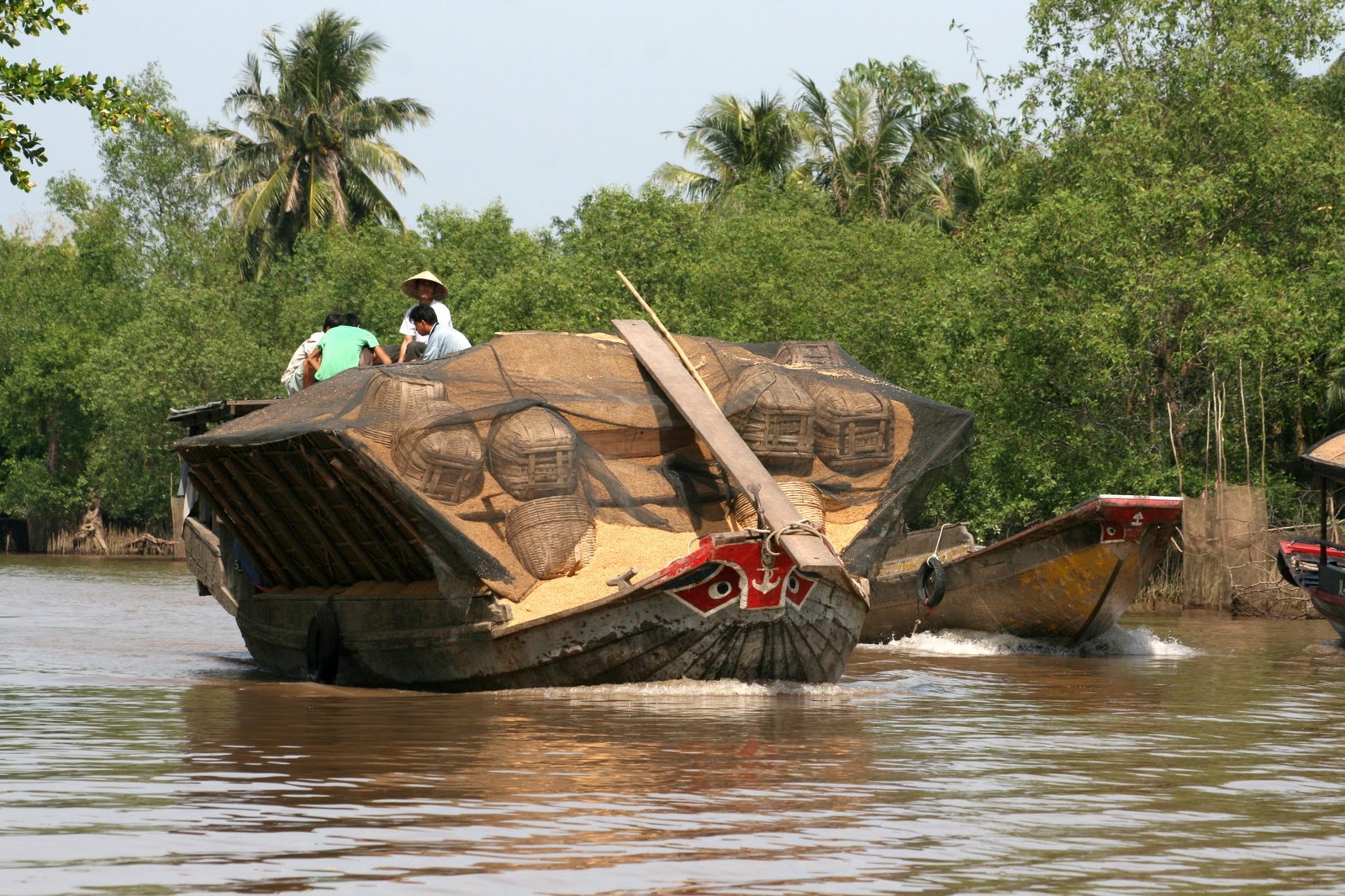
Rice husks on the way to the brickworks (for fuel)
Life in the Mekong Delta revolves much around the river, and many of the villages are only accessible by rivers and canals rather than by road. We visited a floating market and stepped ashore to see a range of small family owned factories operated before having lunch at a homestay farmhouse.
Lunch on the Mekong Delta
Hoi An is a beautiful town near the coast just south of Da Nang in the central part of the country. The Old Town of Hoi An is (a UNESCO World Heritage Site) and is full of winding lanes and Chinese-styled shophouses and a huge marketplace. We missed the annual flooding by just a few weeks when the streets become canals.
2011 flood in Hoi An
On the river next to the marketplace is the wharf where motorcycles, bicycles and passengers board ferries for the commute back to their remote villages upstream from Hoi An.
While almost all shops now cater to the tourist trade, the area has been largely preserved.
Hoi An waterfront
The historic highlight of the town (and now the symbol of Hoi An) is a 16th century Japanese Covered Bridge. It links the Japanese and the Chinese quarters. On both ends of the bridge are altars with guardians; dogs on one side, and monkeys on the other- both symbols of sacredness in Japanese culture. Ancient superstition speculates it is heavy enough to weigh down the vertebrae of a dragon-like monster.
Japanese Covered Bridge
Just out of Hoi An is My Son - a set of ancient Cham Empire temple ruins. They were built using bricks (without mortar) and decorated with sculptures of gods, priests, animals, and mythical battle scenes of battles. The jungle began to reclaim the temples after the fall of the Champa kingdom. More recently they were used by the Viet Cong as a base and were severely damaged by B52 bombing during the Vietnam War.
Temple ruins
Hanoi, the capital city is much smaller that Ho Chi Minh City but it seemed much busier. We window shopped for hours exploring the different precincts near our hotel. We were particularly fascinated by huge the electrical store (TVs, sound systems, mobile phones, white goods, kitchen appliances etc.) which had massive shipping containers stacked four high in the front carpark. They had adapted a builders elevator to store and retrieve the stock.
Shipping container elevator
Near the city of Ninh Binh we visited the massive (new) Bai Dinh pagoda complex which will be the largest complex of Buddhist temples in Vietnam (it is still in construction).
Massive bronze Buddha Sykamuni statue - 10 meters high and 100 tonnes
This pagoda complex currently holds the record for most Arhat statues in SE Asia. The complex includes an astonishing collection of five hundred Arhat statues, each 2.3m high and unique made of local Ninh Binh green stone.
Arhat statues
A 60 tonne bronze bell was to be placed in the main sanctuary of the temple however our guide explained that it was then discovered the building was unable to support the bell's mass.
Over-weight bronze bell
Poetically described as Halong Bay on the rice paddies, we thought that the scenery around Tam Coc was stunning with rugged limestone rock formations soaring skywards from a sea of green rice paddies.
Tam Coc landscape
The area is named after the low limestone caves through which the Ngo Dong River flows. Our memorable Tam Coc experience was to sit back and be rowed along the pristine shallow river alternating between soaring cliffs and the three narrow and low caves. It was a wonderfully serene and scenic trip.
Entering the cave
Halong Bay is a 1,500 square km bay in North Vietnam near the border with China. The bay consists of a dense cluster of 3000 limestone monolithic islands, each topped with thick jungle vegetation, which rise spectacularly from the ocean. Several of these enormous limestone karst islands are hollow containing dry caves and others where the sea has completely eroded a tunnel at seawater level.
Halong Bay
We were not only amazed by the huge number of islands but also the number of junks (replicas) used to show tourists the spectacular scenes. The cooler air unfortunately bought with it the fog. Our views were quite impeded by the fog/smog from the mainland. We still really enjoyed our 2 nights on-board the junk and the time we spent exploring some caves by kayak and on foot as well as a floating fishing village and oyster farm.